Showing posts with label travel in the Philippines. Show all posts

Thursday, January 21, 2016

Christmas (Pasko) lights, decorations, and scenes in Cebu City, Philippines


I apologize for being lazy and not posting anything to this blog for quite some time.  I thought that a good way to follow up to my last post, which was about whale shark watching in Oslob, Cebu, Philippines near Christmastime, was to post some pictures from that same trip - a vignette of sorts - to illustrate what various Christmas decorations/lights look like in the Philippines as well as some typical scenes at Christmastime.   I'll kick off a series of posts with some scenes from Cebu City, and then in the next posts I'll show some small-city and "provincial" (rural) scenes.  For many people who read this post in the United States, Europe, Canada, etc., their impressions of December and Christmastime are those of cold temperatures, often gloomy days with short daylight hours, and often some snow in the air or on the ground... obviously things are quite different in the Philippines!

There are other differences, too, and I find many of the designs of the Christmas (Pasko) lights and decorations to be very charming and distinctly Filipino.  For instance, in addition to the parols (originally a simple paper and bamboo lantern, but often now a nicely crafted brass and multi-colored capiz shell lantern with elaborately timed electric lights), there are many unique Christmas decorations, including such things as an interesting "Santa Claus suspended from a parachute" made from fiberglass.  The following photos are from our December, 2014 trip to the Philippines, and were taken mainly by my wife and our daughter (11 years old at the time).  So, without further ado, here's a look...

These are some nice residential Pasko lights and parols that we found in Cebu City on foot while strolling around after dark:

Nice light display - and it must've taken some effort to get those up into the mango tree!

Some nice parols and Pasko lights

Too bad the brightness of these parols kind of overwhelmed the colors in this photo!

These are on the cooler end of the color spectrum...

Here's a cute circular parol over someone's carport gate

This photo, and the one below it, is of a huge parol that we thought was really impressive.

Many such parols contain multiple lightbulbs and electronic computer chips that control an elaborate pattern of light display, and even music!  

Another nice parol/lights

Parols hanging up in the carport

Lights on the trees in the boulevard in the middle of the street

This photo and the one below it is of the house that has the lights in the mango tree


This simple star-shaped parol, although made of capiz shells and with electric light(s) inside, represents the simplest essence of the old-school parols from the 1800's and before, which were made of bamboo and paper and were lit by a flame to light the way of worshippers to Mass


Now, let's take a day-time trip to the mall (SM City in Cebu, in this case) to do some Christmas shopping.  On the trip to the mall, the traffic can be quite heavy at this time of the year.  Along the way, you're almost guaranteed to encounter sights that you'd never see in December in the frigid northern latitudes of the USA, Europe, Canada, Japan, Korea, etc.,  such as...

A toddler getting a bath in a plastic tub, on the sidewalk!
A vendor selling pomelos (AKA in Cebuano as buongon, and in Tagalog as lukban or suha -- somewhat similar to grapefruit but sweeter) in the street.

The ubiquitous jeepney - the originals of which were crafted post-war from WWII US Army jeeps

...some of which are elaborately decorated
...and another Jeepney, this one emblazoned with a Star of David.

And on the way to the mall, you just might happen to pass a guy driving a pedicab with a load of "puso" (hanging rice), which is a diamond-shaped lump of cooked rice with banana leaves woven around it. 

Arriving at the mall (SM City in Cebu City, in this case), you might find nifty lights to indicate vacant or full parking spots, and an elevator attendant to take you from the parking lot deck to your desired floor... the latter of which I think is a very clever innovation that we in the US should implement in our parking garages!

SM City Cebu with neat Christmas lights on trees.  Can barely see our daughter in the center, with her Auntie and cousin.


Parking space occupied/vacant lights

Elevator attendant, who is constantly being watched by a large woman with lots of jewelry.

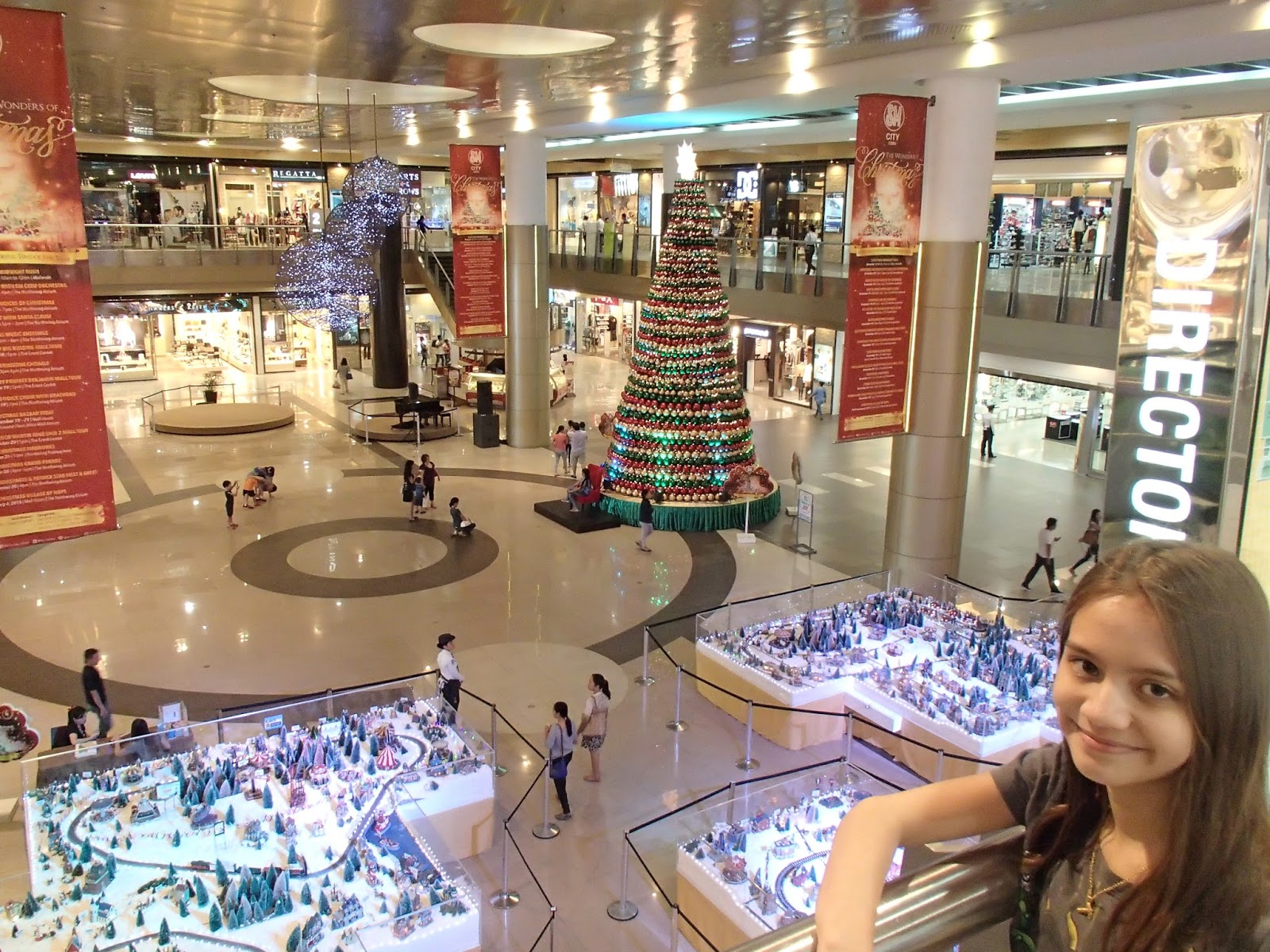
Finally, inside the mall, you'll find some beautiful displays, including a huge Christmas tree made of balls of different colors, and some "Winter Wonderland" dioramas in stark opposition to the balmy tropical weather outside:


Our daughter with the huge ball ornament Christmas tree in SM City, Cebu

A panoramic balcony view of the beautiful Christmas decorations and tree in the SM City Mall, Cebu.  Note the snowy "Winter Wonderland" dioramas below.

So that's a small snapshot of some of the Christmas decorations you might see in a large city in the Philippines, in this case Cebu City.  Next time I'll cover the same from the small town perspective.    :-)


Thursday, January 19, 2012

A bangka (outrigger canoe) trip in Mindanao - up-river and along the shoreline


During our last trip in July/August 2011 to my wife's home town in Mindanao, the Philippines, we hired a traditional means of Philippine maritime transportation -- a small outrigger canoe called a bangka. The bangka is widely used in the Philippines, especially in the provinces outside the major metro areas, for fishing and transportation within and between the islands, and bangkas are very common in the seashore and fishing villages.  Its long, narrow canoe-like banana-shaped hull is wooden and painted with multiple coats of epoxy paint.  Generally it has two outriggers made of bamboo, which act to stabilize the boat in the tropical sea or river waters. The smallest bangkas are usually manually powered with paddles like a canoe or kayak, although the rather small bangka we hired was propelled by a small outboard engine that was I believe was only 5 horsepower.  I've been on a bangka  before and enjoyed it thoroughly, but this time we took a fairly small bangka and traveled on a trip route we had not taken before, which was  really pleasant and exciting for all of us.  For our 8-year old daughter in particular, this was an exciting, educational, and eye-opening trip that gave her exposure to many things she does not have the opportunity to see in the U.S.

The man that my father-in-law hired to take us out in a bangka was a local fisherman with his own bangka, and interestingly he was also a builder of bangkas.  So since my wife and I didn't personally make the arrangements, I don't really have any practical advice or suggestions about looking for a boat for hire other than "use your common sense,  and look for a boat that doesn't leak" (ha-ha!).   I have a definite appreciation for bangkas, and some day I would like to have one of my own.   Onboard the bangka were our Papa/Lolo (my father-in-law; "Lolo" is the Filipino word for grandfather, and is what my daughter calls him), my wife, my daughter, our bangka captain, his son who was about 11 years old, and myself. 

We started off from the beach at my wife's home town in Mindanao (Oroquieta City), and we went a short distance along the shore line until we came to the mouth of the river that flows through the small city.  Since the draught of our little boat was about equal to that of a canoe, it can get into some pretty shallow water.  From the mouth of the river, we went upstream as far as we could.  We passed under a pedestrian suspension (cable) bridge, which can easily accommodate the width of two people walking side-by-side passing in opposite directions, and we kept going upriver.  We next came to the first road bridge, and went underneath it.   There were a good number of people doing laundry in the river under the bridge, and this was really educational for our daughter, as this is something that is not seen in the U.S. and even in our travels in the Philippines we can't usually see too well what's going on under a bridge because our car is traveling over it.  An interesting social and work event, nearly hidden from the sight of all above.


Washing clothes under the bridge

We then had to turn off the motor and use paddle due to it being shallow.  We were able to go upstream about a couple hundred more meters,  at which point we were starting to scrape bottom and get stuck, and ultimately we had to turn around.  Our trusty bangka pilot and his son got out and re-situated the boat when we got stuck pretty well.  Before we turned around, however, we passed some more women doing the laundry, this time out in the middle of the river (since it was so shallow) on piles of rocks, and on several occasions accompanied by a very small child or children.  We waved at these tiny little children, who watched us with a shy fascination perhaps mixed with a little bit of fear. 


Children accompanying mother on rocks in river doing laundry

Little boys with their mama doing laundry on rocks in river
Once we headed back down-river and got past the bridge, we used the motor again, and headed out past the mouth of the river into the sea, following the shoreline less than a kilometer from the shore.   We headed north to find another, smaller river that came out of an area of foothills.  This smaller river would lead up to a village in which Papa had spent time as a young boy with his family farming and evading the Japanese Army during World War II.  Unfortunately, we didn't get many pictures of the beautiful shoreline, but the following picture is one that shows the area along the shore several kilometers north of my wife's home town.  In the photo below, we are approaching a much more rural and agricultural area, with the elevation of the land climbing up from sea level, and you can see behind the clouds the elevation of one of the main mountains in this area.  In this photo, the water is getting just the slightest bit of choppiness from either a bit of wind or from some turbulence from streams and the river coming down from the foothills.  There's a fair amount of desirable hardwood timber grown in those foothills (mahogany, nara, etc.) in addition to coconut trees and camote (sweet potato/yam root crops). 


Bangka boat "Kimberly", as taken from our bangka boat

We next passed by some fish nets that were staked into the water, and entered the mouth of this second, smaller river coming out of the foothills.  This river was much, much narrower than the river that passes through my wife's home town, but apparently also a bit deeper, at least in parts.   The narrowness of the river was really interesting and somewhat exciting to my daughter and me, but my wife was worried that there would be snakes in the thick trees and bushes that lines the shores (her worries were unfounded, at least during our trip).  We saw many nipa huts (bamboo houses), which near the river are typically elevated up on stilts, in comparison to nipa huts you'll see inland away from the rivers, which are not raised up as high.  Usually, sitting on the bank of the stream in front of these houses are brightly colored bangkas.  As shown in some of the photos below, bangkas represent an important means of transportation for villagers living along the streams and rivers of provincial (rural) Philippines.  Ultimately, we realized that this was not the river Papa was looking for -- it was a bit further north along the coast line.  Due to time constraints, however, we decided to just continue our trip and just "go with the flow" (or in our case since we were heading upstream, go against the flow).


Small bangka passing by, fish nets staked up in background

Bamboo nipa hut houses on stilts, bangkas docked in front


Family (mama, papa, 3 boys, dog) in bangka passing by on this narrow river...  a "fluvial road"

Another nipa hut house, with a brightly colored bangka in front


Family onshore doing some work near their bangka boats

We enjoyed our trip, and a great time was had by all.  Taking a bangka trip along shore and upstream is definitely something on my "highly recommended" list of things to do if you visit the rural coastal provinces of the Philippines, and it is especially fun to do if you have children.  Our daughter got to experience all of the sights, smells, and sounds of this trip, and also got to wave hello to a lot of families and little children along the banks of the rivers.    Papa got to reminisce about some of the trips along the same coastline he took as a child and as a teenager.  And my wife and I got to relax and really enjoy being out on the water, taking in the experience and enjoying the company of family.  Although our trip probably lasted about 3 hours, I could have spent literally all day on the bangka (despite having long legs in a small boat). I think next time we will bring along a picnic lunch and try to spend more than 3 hours out on the bangka.


Tuesday, January 3, 2012

Beautiful Boracay, Philippines - banana boats, jet skis, and parasailing

These are some photos of water sports we enjoyed during a family trip to Boracay in 2008.  I'll write a bit more about Boracay and the experiences we had there in a later post.  The jet skiing is self-explanatory, and was incredibly fun -  in my opinion the most fun and thrilling of all three water sports shown in the photos below, although I did not personally indulge in the parasailing and only watched from the back of the boat.  The icing on the cake was (were) the beautiful views we got of Boracay and the sea... a truly gorgeous place and an equally beautiful day.  All of these were very enjoyable, but unfortunately our daughter was too little to be able to ride on anything with the exception of the speed boat towing the parasailing parachute.

Gorgeous view of parasailing fleet, Boracay, Philippines

Water sports at Boracay
The jet skis were really nice and handled really well, especially when going full throttle - a good, exciting ride that really gives you some good bounce.  I rode with my wife behind me, then let her drive  with me as the backseat passenger (she was actually pretty good).  Finally, I went solo and really opened up and cut loose.  It was a blast, but I felt kind of bad because I forgot all about the time and the guys who managed the place had to send someone out on a jet ski to get me because I went a bit over with my allotted time.  I would have loved to have taken it out all day, and to have gone far beyond the boundaries they permitted me to take it.  Would be neat to rent one, but I doubt that is possible without a guide, because  one would have to have a really intimate knowledge of where all the coral reefs are in a particular place.


Pre-flight dockside check-out, Boracay, Philippines


Off we go!

My wife and I coming back to dock on jet ski, Boracay


My wife's turn to drive
My wife at the helm... aye-aye, captain!


The guy who had to remind me that my time was up!

Coming back in to the dock


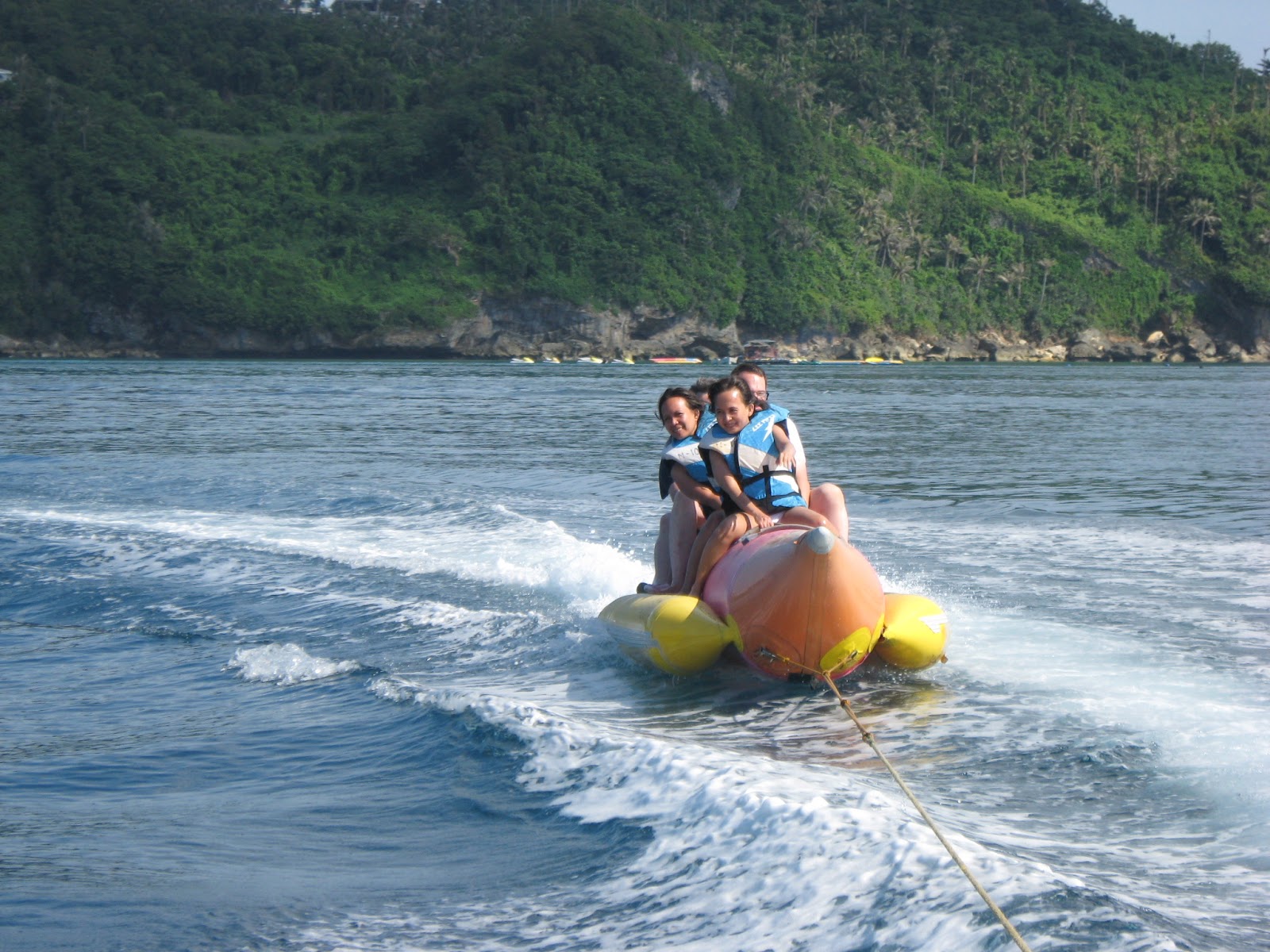
The banana boat -- not a boat on which bananas are transported, but an inflatable banana-shaped raft towed by a speed boat -- was also fun and can accommodate a pretty decent-sized group of people, but was actually a bit more tame of a ride than I had expected... quite cushy and stable.  I had expected it to be more bouncy and that it would catch more "air" from the waves.   But it was fun, nonetheless, and everyone really enjoyed it... lots of laughs from all of our group.

"Vacation all I ever wanted, vacation had to get away..."


Banana boating in Boracay
Beautiful shoreline scenery of Boracay

Hoppin' and boppin' on the banana boat

Banana boat hitting the wake at Boracay


Finally, parasailing.  My wife and I have done some pretty bold and dangerous things, including white water rafting on a Class IV rapids on the river at Cagayan de Oro in Mindanao.   But since our daughter wanted to come on the boat with us (and since she hadn't had the chance to ride the other rides), we opted out and her two sisters who accompanied us have their chance at cheating death.  Just kidding - in all fairness it seemed safe and the operators appeared to be responsible.  But that parachute sure does get far, far up in the sky and far away from the boat!

My two sisters-in-law parasailing at Boracay
Don't cut the rope, Dong

Parasailing chute

Kicking up a good wake under the cumulus clouds


How's the weather up there?

Can barely see them any more


LinkWithin

Related Posts Plugin for WordPress, Blogger...