Showing posts with label provinces. Show all posts

Sunday, December 11, 2011

Our tour of a small-town public elementary school in the Philippines

During our July/August trip to the Philippines to visit my wife's family, we wanted our daughter, who was about to turn eight years old, to witness the Philippines from many different angles and learn further about her cultural heritage as a Filipina-American.  Many times when people visit another country, their point-of-view as a tourist is biased and limited by staying in the "touristy" areas, traveling with their fellow countrymen and speaking only in their native tongue (this often occurs on package tours), and eating cuisine that is familiar and most closely similar to what they eat in their home country.  We hope to thwart this mind-set and allow our daughter to see life in the Philippines not only from the aspect of the beach resorts, luxurious shopping malls (most of which are larger and nicer than the ones in many metropolitan areas of the U.S.) and the westernized fast food restaurants. The rural areas of the Philippines, referred to by Filipinos as "the provinces", are filled with natural beauty and offer ample opportunity for our daughter (and me) to learn about her heritage, as well as Philippine culture and way of life, agriculture, flora and fauna, trade and micro-manufacturing processes, you name it.  One of the coolest examples of the latter was going to a blacksmith-style workshop where bolo  knives (machete) and sangot  (scimitar or sickle curved machete)  are fashioned out of springs from the suspension of a car.  Importantly, these experiences are educational for all of us, and instill in our daughter a respect for the Filipino traditions and way of life, and an appreciation of the indomitable spirit of most of the people, many of whom are much less economically privileged.

In particular, we wanted our daughter to get a good sense of what school life is like for children who are largely from families who rely on subsistence agriculture for a living - kids who are just like her in almost all ways, but who are truly facing some economic adversity.   In August in my wife's home town in Mindanao,  we arranged for the wife of my wife's distant cousin, who is a 4th-grade teacher at a public elementary school, to give us a tour during an active school day.    Schools in the Philippines have a school year starting in June and ending in March, so when we visited in August (during our daughter's summer vacation from her school in the U.S.) school was in full session.   

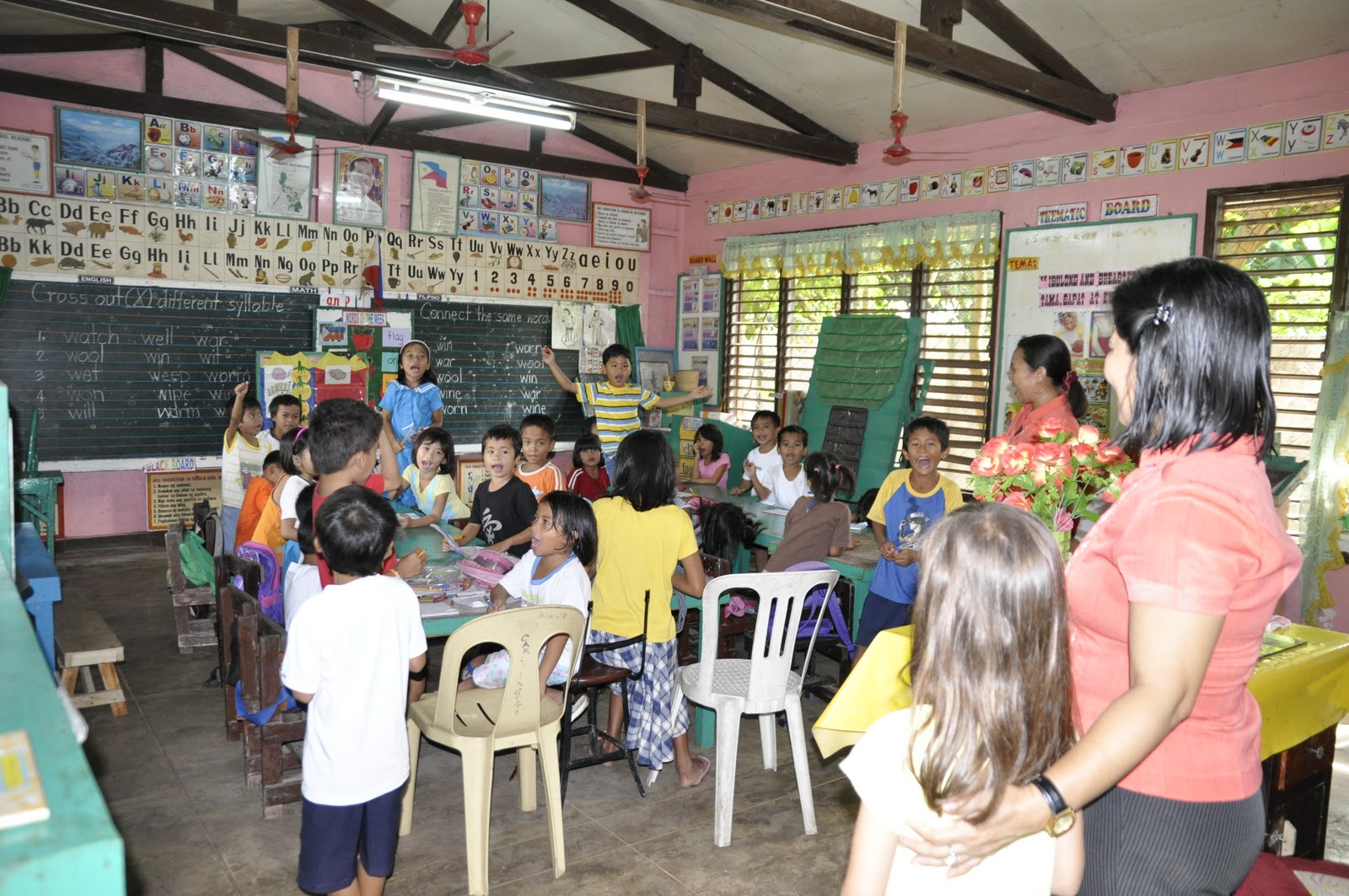
We arrived first thing in the morning, in time to see the flag raising ceremony and national anthem, followed by some unstructured group physical activity (mainly "hokey pokey" type dancing and stretching).  We next went inside the classrooms, grade by grade starting with 4th grade, then 3rd, then 1st, then peeked in the other grade classrooms.  We also got to see the canteen where the children eat, and can purchase some snacks or bread. Since there is no winter in the Philippines and the weather (at least in Mindanao) can be quite hot and humid all year long, the schools are built in an open-air plan with no glass in the windows.  Instead, large vented "grill" windows similar to Venetian blinds span the entire length of the room, bringing fresh breezes into the classroom.   The photos of the elementary we visited are fairly representative of the same style architecture and layout of many of the public elementary schools I've seen in the provinces, small towns, or rural areas of the Philippines. 


The children were all very delightful and proud to show us their classroom, greeting us in unison (in English) and thanking us for coming.  They were particularly happy to interact with our daughter, and they were as honored to have her as a visitor as she was to be their guest.  Like many other school children in the Philippines, some of the children attending this school cannot afford to even buy a single piece of bread for their lunch.  Sadly,  we encountered a bright and smiling little 12-year-old girl, who had only just started first grade.  She had been held back by her parents until this year due to the need to keep her at home so she could help with farming.  Curriculum, books, notebooks, and school supplies are all an economic issue and hardship, not just for the students, but also for the teachers - unfortunately, the necessary items for education do not always make it to the final destination where they are needed most.  This visit truly provided a new perspective for our daughter (and indeed for all of us), helping her to realize how fortunate she is as a student in her public school district in the U.S.   But it also showed her that despite the economic adversity these kids face daily, they are bright, resourceful, kind, caring, delightful, and very much like herself in so many ways.  A great life lesson for a not-quite 8-year-old, and for all of us!


Post-script 03/01/13...    This post has been the most popular so far in terms of all-time views on my website, but oddly enough, it has gotten very few comments in comparison to some of my other posts.  

Preparing to raise the flag
Raising the Philippine flag
Stirring the pot exercise
"Hokey Pokey" morning exercise

Sidewalk between open-air classrooms

First time meeting the 4th grade class

Children greeting our daughter in unison
Children greeting us, responding to teacher

Reciting Philippine Pledge of Allegiance in Tagalog

Boys will be boys


Girls with classroom reading materials

Open-air public elementary school classroom in Philippines


Students with teacher in Philippine public elementary school 

On-site canteen where students get their lunch


Thursday, November 17, 2011

My family ties to our "home away from home": the Philippines

In an earlier post I mentioned that within this blog I would discuss traveling in the Philippines.  Just to take a little break from posting about early U.S. coins and American/Ohio history for a bit, and as a prelude to actually writing about my experiences and travels within the Philippines, I'd like to give a bit of background about how I came to visit the Philippines in the first place.

At the age of 24, I met my lovely Filipina wife-to-be back in early 1993, while she was traveling with her parents visiting family in the United States.  It just so happened that her cousin grew up in the U.S. and is married to my older brother, so of course my brother and sister-in-law introduced us.  The rest, as they say, is history.  We hit it off right away, and have been married nearly 18 years, with one child.

After two years of marriage, we took our first trip to the Philippines in 1996. I thoroughly enjoyed my visit, but had much to learn about the culture, traditions, infrastructure, and daily rhythms of life in the Philippines.  As an American of primarily German and small amount of Irish ancestry, I admittedly experienced some culture shock, one could say, but also a very profound respect and affection for the hospitality, warmth, and traditions of the people of the Philippines.   The latter was not entirely a new concept to me, as I had quite some experience since childhood interacting with Filipino families mainly from Northern Mindanao and Cebu, who had immigrated to my home town in the early 1970's during the Marcos administration.  Having Filipino friends and classmates introduced me to many of the concepts of the Filipino nuclear family and respect for elders, various Philippine foods such as cassava cake, bud-bud, lumpia Shanghai, and gave me some opportunities to learn a few vocabulary words in the Cebuano or Visayan dialect.   My brother's ties to his future wife's family, starting in 1982, gave me further opportunity to visit and interact frequently, so that by the time I asked my wife's father for her hand in marriage (according to Filipino tradition), I had the full endorsement of my wife's uncle, who knew me since I was 13 years old back 1982.   That being said, observing a microcosm of Filipino culture here in the United States amongst a small number of relatively Americanized Filipino families only gave me a slight clue of what life might possibly be like in the Philippines.

In upcoming posts, I'll detail many of the adventures we've had as a family staying and traveling in the Philippines. I will attempt to provide some general information, tips and reviews about traveling in the Philippines, particularly in northern Mindanao and in and around Cebu, but also including Boracay, Baguio, and the Manila environs.  My family and I have a penchant for spectacular natural features (waterfalls, beaches, mountain vistas, etc.), historical sites, and even shopping malls, and I will try to highlight and discuss objectively many of these destinations.   During our visits, we also try to balance visits of luxury beach resorts and hotels with visits to dramatically more modest settings, particularly in the rural provinces.  There, in the provinces, lie arguably the most beautiful features of the Philippines and its people - verdant rice fields backdropped by hazy emerald volcanic mountains beneath billowing cumulus clouds with farmers using carabao (water buffalo); bamboo-thatched nipa huts as a primary  means of housing for many subsistence farmers, "multicab" trucks of amazingly narrow width carrying full loads of people or agricultural products, gorgeous coconut plantations with sweeping seaside vistas, mahogany groves interspersed with camote (root crop) in the foothills and mountains, and along almost every road every few hundred meters, the ubiquitous nipa or corrugated steel-fronted sari-sari roadside store with its ubiquitous Coca-Cola sign stating the family name of the shop owner.  Additionally, I will discuss aspects of Philippine culture and the Filipino people, as well as the joys and challenges of traveling as a family in the Philippines.

LinkWithin

Related Posts Plugin for WordPress, Blogger...